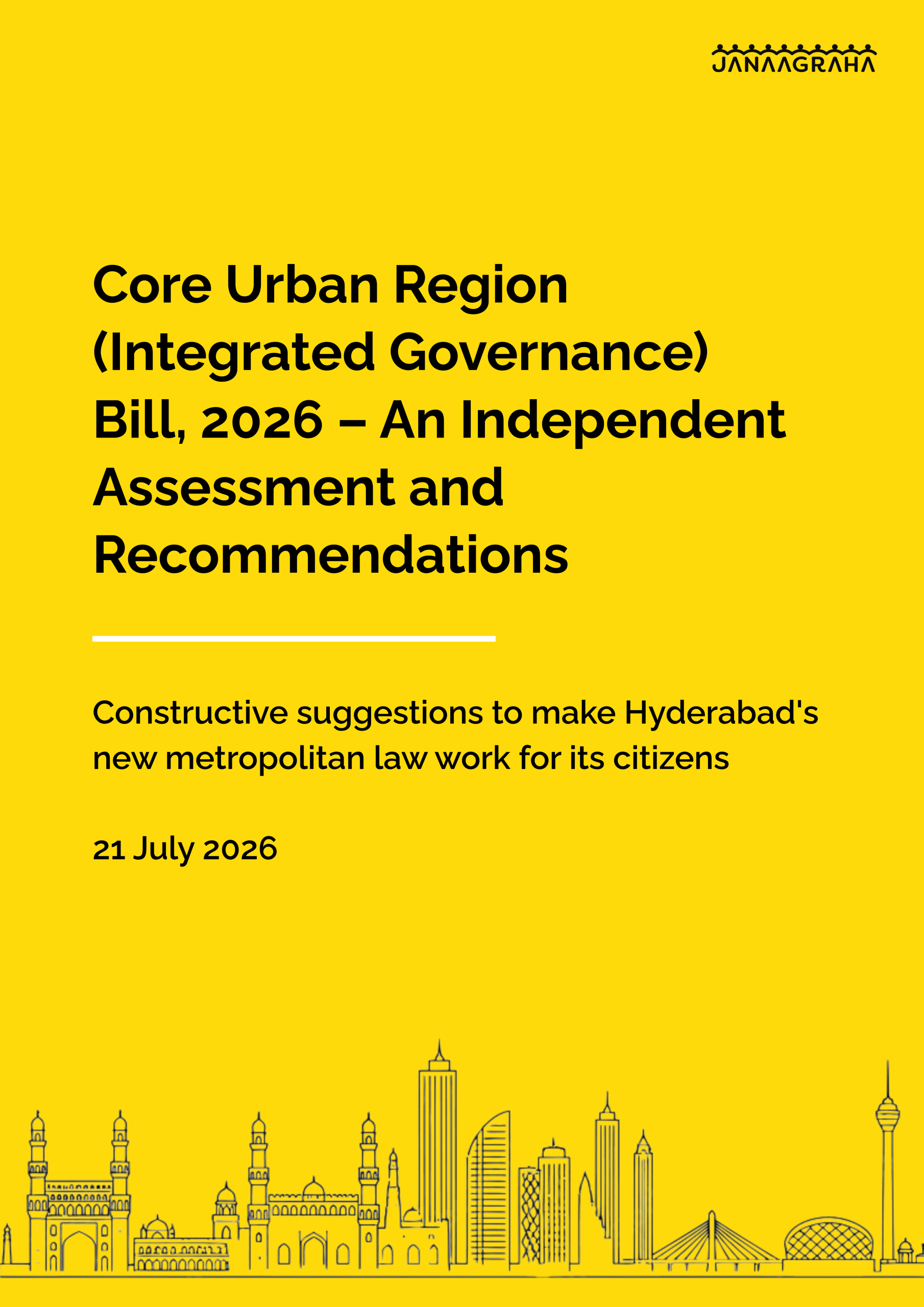
The draft Core Urban Region (Integrated Governance) Bill, 2026 (“CURE Bill”) represents one of the most significant opportunities to redesign metropolitan governance in Hyderabad in over seven decades. By replacing the Greater Hyderabad Municipal Corporation Act, 1955, the Bill seeks to create a new governance framework for one of India’s fastest-growing metropolitan regions.
The Bill introduces several important reforms, including greater transparency through mandatory public disclosures, digital governance, and a common billing framework; capital value-based property taxation; a stronger climate action framework; and gender inclusion. These reforms have the potential to significantly improve the quality of life for Hyderabad’s residents while strengthening the city’s ability to drive Telangana’s ambition to become a USD 3 trillion economy by 2047.
Janaagraha conducted an overall assessment of the CURE Bill based on our City-Systems framework, answering five questions:
- Will the city be planned better?
- Will elected representatives have more power?
- Will the government become more transparent and accountable?
- Will citizens have a stronger voice in governance?
- Will the institutions actually be able to deliver?
We identify five major shortcomings in the Bill’s current design, covering key aspects like metropolitan planning, institutional design and accountability, urban design, empowered mayors, councils, and citizens, and urban local capacities. We also identify gaps in more than 130 provisions in the Bill that dilute its ambition.
Janaagraha has prepared clause-by-clause recommendations on the Bill. The recommendations are intended to strengthen the Bill’s objectives by improving institutional clarity, democratic accountability, implementation capacity, and metropolitan planning and governance.
 Previous