The Magic of Participative Budgeting
First published in Janaagraha Times (Vol. 1 Issue 3, March 2002) by Ramesh Ramanathan, Co-founder, Janaagraha.
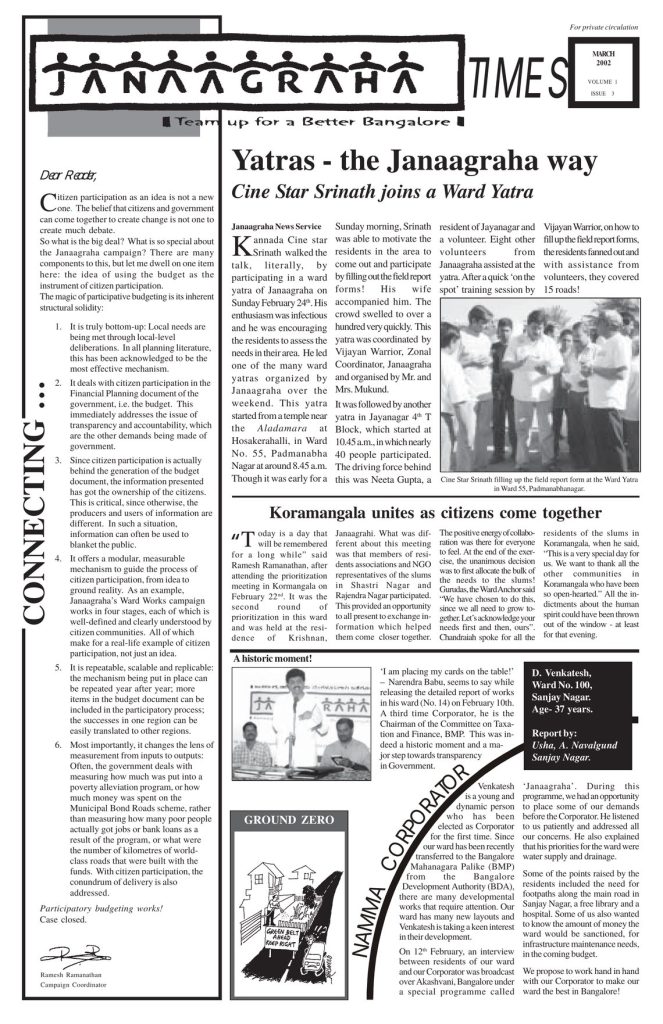
Dear Reader,
Citizen participation as an idea is not a new one. The belief that citizens and government can come together to create change is not one to create much debate.
So what is the big deal? What is so special about the Janaagraha campaign? There are many components to this, but let me dwell on one item here: the idea of using the budget as the instrument of citizen participation.
The magic of participative budgeting is its inherent structural solidity:
- It is truly bottom-up: Local needs are being met through local-level deliberations. In all planning literature, this has been acknowledged to be the most effective mechanism.
- It deals with citizen participation in the Financial Planning document of the government, i.e. the budget. This immediately addresses the issue of transparency and accountability, which are the other demands being made of government.
- Since citizen participation is actually behind the generation of the budget document, the information presented has got the ownership of the citizens. This is critical, since otherwise, the producers and users of information are different. In such a situation, information can often be used to blanket the public.
- It offers a modular, measurable mechanism to guide the process of citizen participation, from idea to ground reality. As an example, Janaagraha’s Ward Works campaign works in four stages, each of which is well-defined and clearly understood by citizen communities. All of which make for a real-life example of citizen participation, not just an idea.
- It is repeatable, scalable and replicable: The mechanism being put in place can be repeated year after year; more items in the budget document can be included in the participatory process; the successes in one region can be easily translated to other regions.
- Most importantly, it changes the lens of measurement from inputs to outputs: Often, the government deals with measuring how much was put into a poverty alleviation program, or how much money was spent on the Municipal Bond Roads scheme, rather than measuring how many poor people actually got jobs or bank loans as a result of the program, or what were the number of kilometres of world-class roads that were built with the funds. With citizen participation, the conundrum of delivery is also addressed.
Participatory budgeting works!
Case closed.