In most government schools, civic education remains confined to textbooks—abstract, disconnected from everyday realities, and rarely translating into meaningful participation. Students are seldom enabled to identify civic issues in their neighbourhoods, think critically about them, or work collectively to address them.
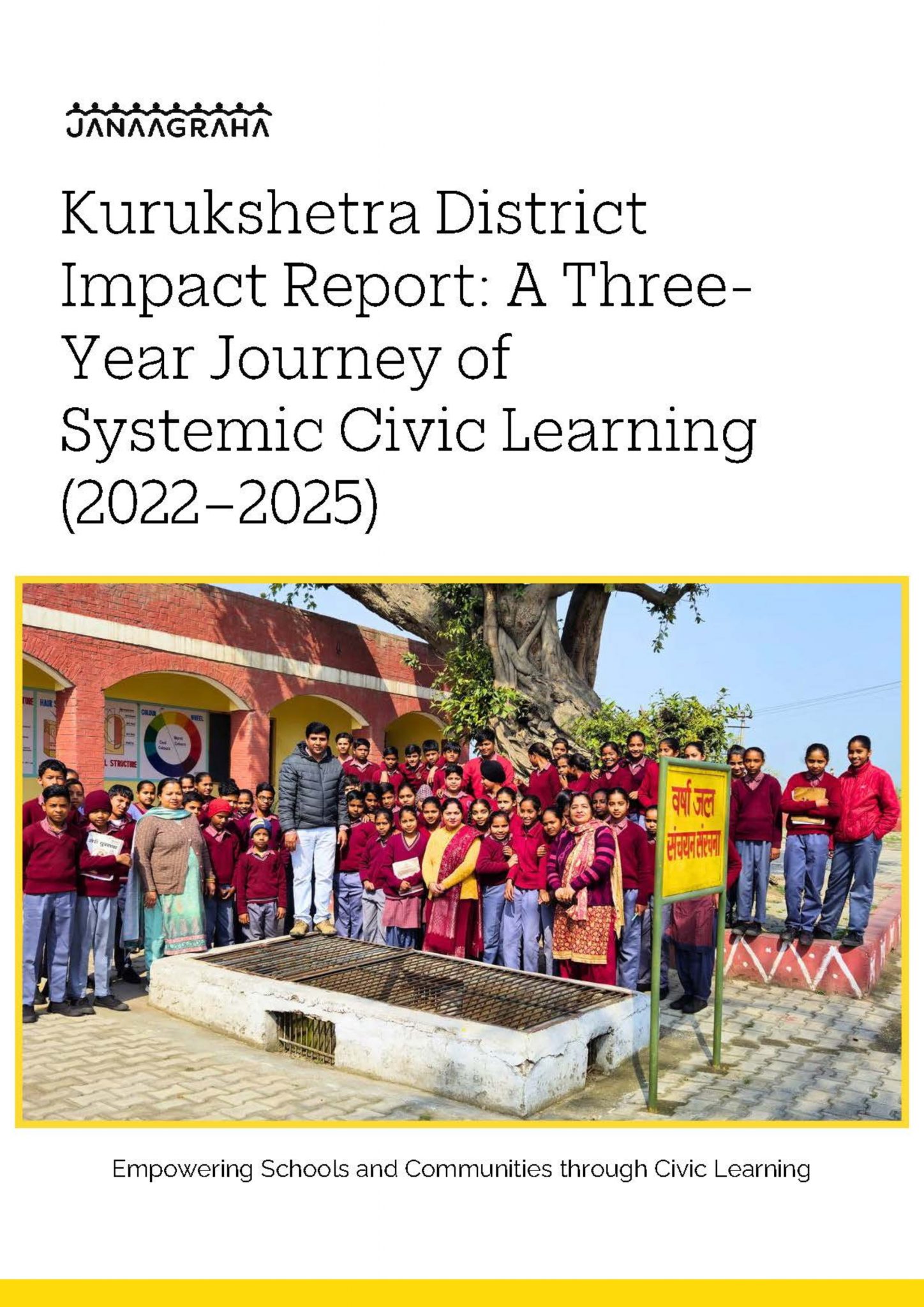
The Kurukshetra Model of the Civic and Social Action Project documents a three-year initiative (2022–2025) that embedded civic learning into the regular functioning of 95 government schools across Kurukshetra district, Haryana. Implemented in partnership with the District Administration, Department of Education, and DIET, the programme engaged over 23,800 students and 350 educators through classroom-based modules, teacher capacity-building, and student-led action projects anchored in community engagement.
The report examines how civic learning moved from instruction to application: students conducted 180+ Local Action Projects addressing water conservation, waste management, health awareness, and gender equality in their schools and neighbourhoods. Teacher-led Bal Sabhas evolved from school assemblies into democratic platforms at the school, block, and district levels, where young people identified challenges, engaged with local governance structures, involved community members, and implemented collective solutions.
The report documents not only outcomes, but also the institutional pathways that made them possible—curriculum integration, teacher training, school leadership engagement, district ownership, and continuous monitoring and learning—demonstrating how civic education can become a sustainable part of the public education system and nurture active, informed, and responsible citizens at scale.
This report offers state and district education departments and civil society organisations a practical blueprint for embedding civic learning within government schools.

 Previous